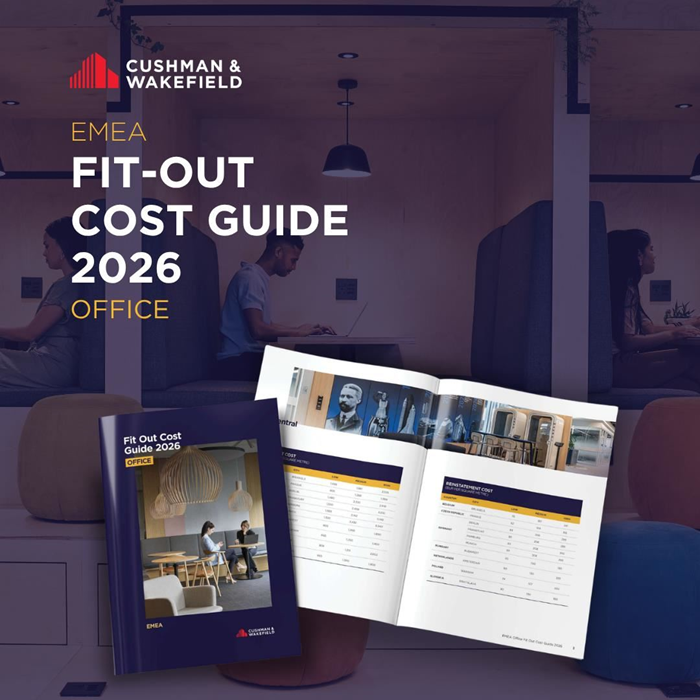
EMEA OFFICE FIT OUT COST GUIDE 2026
EMEA Office Fit Out Cost Guide 2026 report provides a comprehensive analysis of the current status and future outlook of office interior fit-out costs across the Europe, Middle East, and Africa (EMEA) region. Bringing together multidimensional factors such as macroeconomic developments, office market trends, cost dynamics, and contractor expectations, the report offers a strategic framework to guide companies in their investment and budgeting decisions. The study also presents comparative cost data across 53 cities, highlighting regional differences.
Macroeconomic Outlook and General Trends
One of the report’s key findings is that the European economy has shown relative resilience despite significant geopolitical and economic pressures in recent years. In particular, the Russia–Ukraine war, tensions in the Middle East, and rising protectionist trends in global trade have increased economic uncertainty. Measures such as U.S. import tariffs have affected global trade flows while also putting pressure on supply chains. Nevertheless, Europe recorded approximately 1.5% economic growth in 2025, marking one of the strongest performances of recent years.
As the market enters 2026, economic growth is expected to slow. However, anticipated interest rate cuts and a strong labor market indicate the potential for renewed acceleration in growth from 2027 onward. At the same time, persistently high wage levels continue to drive labor costs upward, maintaining cost pressures particularly within the construction and fit-out sectors.
Office Market and Demand Dynamics
Analysis of the office market shows that corporate occupiers remain active, with approximately 10.5 million square meters of office leasing completed in 2025. This figure was only 3% below the previous year, demonstrating the market’s resilience. Demand for high-quality (Grade A) office spaces has continued to increase, while interest in lower-grade offices has declined. This trend indicates a clear quality-driven divergence within the market.
Vacancy rates have generally remained low, standing at around 3.5%. However, the slowdown in new supply may create downward pressure on vacancy rates in the future. Demand is expected to recover in 2026, reaching approximately 2 million square meters of net absorption.
Costs and Contractor Perspectives
In terms of fit-out costs, the report indicates that cost increases will continue in the short term, although at a slower pace. In 2025, average costs rose by 3.8%, primarily driven by higher labor costs and ongoing supply chain challenges. Material prices, by comparison, have experienced more moderate increases.
According to the contractor survey, 78% of respondents expect further cost increases. However, most anticipate these increases will remain relatively moderate. The majority of participants also stated that labor costs are expected to continue rising. Regarding project timelines and backlog volumes, the situation appears generally manageable, with more than half of respondents reporting backlog periods of five months or less.
In addition, the report emphasizes that cost pressures stem not only from material prices but also from broader economic conditions and regional differences. Cost increases are particularly pronounced in Central and Eastern Europe, whereas markets such as Germany have experienced more limited increases.
Regional Cost Differences
One of the report’s most striking findings is the significant variation in office fit-out costs across cities in the EMEA region. These costs are categorized into low, medium, and high segments depending on factors such as material quality, technological infrastructure, sustainability criteria, and spatial design features.
Cities such as London, Munich, and Copenhagen rank among the highest in terms of cost per square meter, while certain cities in Eastern Europe and Africa remain at lower levels. Istanbul is positioned within the medium-cost segment of this distribution.
Office fit-out costs in Istanbul range from approximately €1,210 to €2,470 per square meter, with an average cost of around €1,630/m². This level remains below mature markets such as London (€2,668/m²) and Manchester (€2,309/m²), while exceeding Eastern European cities such as Belgrade (€800/m²) and Ljubljana (€900/m²). Similarly, reinstatement costs in Istanbul stand at approximately €173/m², placing the city within the medium-to-upper range compared to many regional markets.
Within this context, Istanbul stands out as a competitive yet still accessible office market for global companies, offering a balanced combination of cost and quality.
Overall, the report indicates that total project costs are typically distributed as follows: approximately 58% construction/fit-out works, 18% furniture, 13% AV/IT systems, and 11% professional services.
ESG and Sustainability Approach
The report highlights that sustainability (ESG) criteria are becoming increasingly decisive in office design and investment decisions. Offices are now evaluated not only in terms of aesthetics and functionality but also based on long-term performance and environmental impact. Companies are integrating objectives such as reducing carbon emissions, improving energy efficiency, and using sustainable materials into their fit-out projects.
ESG integration is addressed across four key phases: site selection, pre-design, design and implementation, and operations. The report particularly emphasizes that decisions made at early stages have a critical impact on both costs and long-term performance.
Conclusion
Overall, the report demonstrates that the office fit-out market across Europe, the Middle East, and Africa (EMEA) has maintained its resilience despite challenging economic conditions and continues to hold balanced medium-term growth potential. Cost increases are expected to continue, albeit at a more moderate pace. The growing preference for higher-quality office spaces, the increasing importance of sustainability criteria, and regional market differences are emerging as the key factors shaping the future of the sector.
In this context, companies must take into account both macroeconomic uncertainties and local market dynamics when making investment decisions, as these considerations are critical for effective cost control and strategic planning.
This content was prepared by Cushman & Wakefield. To access the original source: "Global Office Fit Out Cost Guide 2026 | Cushman & Wakefield”
Authors:
Dr. Dominic Brown
Head of International Research
dominic.brown@cushwake.com


![System.String[]](https://cdnc.re-os.com/content/d13c7a26-f1a0-4f46-9a2a-4e294ee3bec0.png)
![System.String[]](https://cdnc.re-os.com/content/0f90cdc8-703f-40ee-8579-4b83c6f52cff.png)
![System.String[]](https://cdnc.re-os.com/content/f655c04d-3e7f-41ec-8dd1-e98d695d1327.png)
![System.String[]](https://cdnc.re-os.com/content/1bb9cd13-3717-405a-aa92-1cbfd289eb99.jpg)
![System.String[]](https://cdnc.re-os.com/content/a11cdfff-990c-4ed5-b6a7-2438444fa0c6.png)
![System.String[]](https://cdnc.re-os.com/content/715bbab9-66c7-4f64-afe3-221956945a46.png)